––– Afternoon (talk/demo/workshop) –––
Talk/demo/workshop: Inclusive affordances: On-the-air synthesiser performance
An interactive and hands-on talk and demonstration on the history and practice of the theremin.
- Time: Monday 16 February, 2–5pm
- Location: ECA West Court (ECA Main Building, Lauriston Place)
- Tickets: Eventbrite (Theremin Talk/Demo/Workshop)
Please note: Tickets are limited to 25 attendees (first come, first served!)
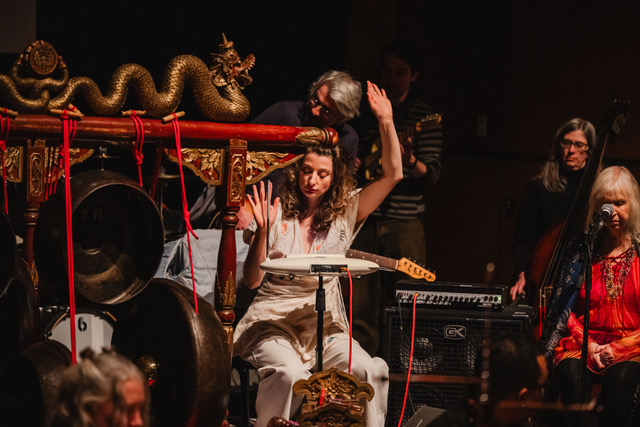
Dr Jessica Argo, plays the Moog Theremini, a gesture-controlled synthesiser. This is a mutation of the monophonic theremin invented in 1920 (a by-product of Leon Theremin’s attempts to build a device to detect changes in air density, a poison gas alarm), an electronic instrument that the player does not touch; rather its antennas generate an electromagnetic field for the player to dance through. The theremin was first popularised in concert halls by injured violinist Clara Rockmore (who turned to this instrument for its more inclusive affordances), recently techno-feminised by Dorit Chrysler in her site-specific surrealist film at the CERN Large Hadron Collider (she also devised an installation where the limbs of Alexander Calder’s mobiles performed her Moog Theremini), and again returned to concert halls by Carolina Eyck. The theremin has a history of ethereal, magic (witchiness), femininity, balletic, corporeal gestures (the Moog Theremini instructions guide the player to move their hands as slightly as a butterfly’s wings!) – which can be subverted by punk performers like Skin from Skunk Anansie, who at Glastonbury 2022 broke the rule of no touching, when she licked the antenna of a premium Moog Etherwave, before smashing it on the ground.
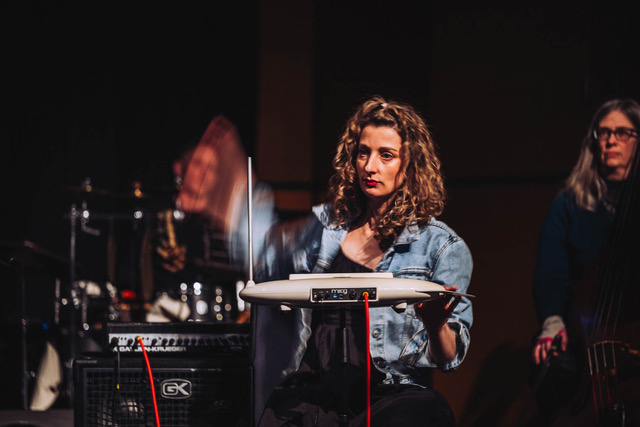
Dr Argo will present a lecture-demonstration, in which she will share audio visual documentation and reflective insights from large ensemble compositions where she encourages heightened expressive physicality from musicians in Glasgow Improvisers Orchestra and international collaborators (such as International Contemporary Ensemble and Australian Art Orchestra).
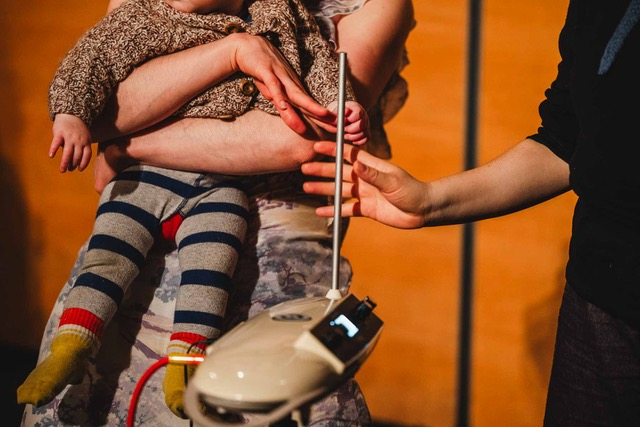
This will be followed by an interactive musical improvisation workshop led by Dr Argo. Participants will have the opportunity to engage “in dialogue” with the Theremini as improvising instrument, and are encouraged to bring their own noise-makers (a musical instrument, or something entirely different!). At the end of the workshop, participants will have the option to try out a range of sound-making devices, including fully functioning theremins, under the guidance of staff from the Reid School of Music.
People involved: Dr Jessica Argo, Prof Annette Davison. Dr. Jessica Argo is Programme Leader for BDes Sound for Moving Image at Glasgow School of Art, a composer for improvising ensembles and an experimental filmmaker/sound artist, drawn to music for community world-building – improvisation to bridge international distance and sustain intergenerational learning; improvising for queer affirmation; deep listening, emotional expression, mood regulation and liberation from patriarchal, ableist and economic oppression. Argo uses embodied synthesis (Moog Theremini, contact microphones, voice) to conjure alien sound, extended from her physical body or other acoustic bodies (cello). She has conducted neuroscience research, films in white cube galleries, dance clubs and hybrid room-and-ZOOM orchestra theatre performance.
––– Evening (concert) –––
Opening Concert: The City Sings / 900 Voices
A spectacular two-part opening concert for Week of Sound 2026 will see a large community choir and orchestra perform in the historic ECA Sculpture Court (The City Sings), interwoven with the ever-evolving multichannel piece 900 Voices – an installation created entirely from the diverse voices of Edinburgh’s communities.
- Time: Monday 16 February, 7-8pm
- Location: ECA Sculpture Court (ECA Main Building, Lauriston Place)
- Tickets: Eventbrite (Opening Concert)
This will be a highly collaborative event, in which students and members of the public are invited to take part by joining our community choir for a workshop on Sunday 15 February to learn and practise the music for The City Sings.
More information about this workshop, and to sign up, is available via a separate Eventbrite.
More information about the Opening Concert
The City Sings is a collaboration between the Stockbridge and New Town Community Orchestra (directed and conducted by Louise Martin) with Music in the Community at the University of Edinburgh, and singers from across the city. It is a composition by Dee Isaacs.
The words are adapted from Jon McGregor’s prose in his book If nobody speaks of remarkable things (2002). The text draws us into a lyrical and rhythmic landscape and asks us to observe, remain still and listen. In the music you will hear the early morning, the buses and cacophony of street life, and finally our ‘community’ coming together singing to celebrate our city.
900 Voices is a spatial sound art installation by Zoë Irvine, Jules Rawlinson, and Lindsay Perth. It explores notions of belonging, connection and community, blending voices from hundreds of Edinburgh citizens.
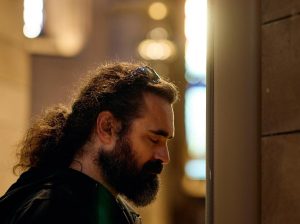
The work was commissioned in 2024 to celebrate the 900th anniversary of Edinburgh’s St. Giles Cathedral. The work ran in the Cathedral throughout the Edinburgh International Festival in 2024 and was visited by over 3000 people. The work is restaged here in the ECA Sculpture Court, which has a similar acoustic character to the Cathedral.
Over 285 people from diverse areas, backgrounds and communities in Edinburgh were interviewed to produce an archive of conversations of over 80 hours of audio and the sound installation runs through a cycle of different ways of exploring, revealing and blending moments of this conversation material at the heart of the work. The 900 Voices installation places recorded conversations in conversation with one another and its listeners, creating a dynamic and evolving polyphonic soundscape.
The 900 Voices installation uses a variety of computer procedures to select, combine and place sounds in real-time. A computer programme makes new choices each time the work runs to search the archive of conversations for words and themes. Sometimes single words will emerge and at other times longer reflective sections allow listeners to encounter and engage with individual contributions. The installation works with the rhythms and tonality of conversation in more abstract ways too. Playful echoes, choruses of frozen speech and rippling phrases are generated, activating and celebrating the musical character of voice and the acoustic character of reverberant space.
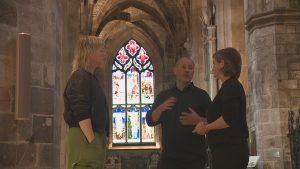
The subject matter is broad, sometimes touching on difficult experiences. To talk about belonging it was useful to talk about not belonging too. You may hear fragments of personal experiences of prejudice and other challenges, as well as insights into belonging and connection. Please respect the listening experience of others.
900 Voices was created with support from St Giles Cathedral, Creative Scotland, Edinburgh International Festival, Edinburgh Napier University and The University of Edinburgh.